As we enter into the final few days of the election, I’m updating my first two sets of predictions and musings. Barring some shocker, this is it…
Very little of the below, in its basics, has changed—my view of this election really goes back to early in the year and has been set in place since certainly March. For those who want more targeted, narrower musings up to Election Day (and, maybe, beyond…), check out my Facebook page.
BOTTOM LINE:
Biden will win. And chances are high it’s an Electoral College landslide [one note about the map: I didn’t quite get the coloring right on “intensity” of each state i.e., Washington state is a solid blue like Oregon and Florida should be lighter blue as in “leaning”…sorry…my bad on the techhie part].
I am not saying Trump can’t win—I think it’s possible mainly because of the intensive voter suppression efforts Republicans are launching everywhere. But, I think it is simply very unlikely.
I am not changing my predictions map from the last set of predictions: 413 EVs for Biden (yes, including TEXAS—see below); 126 EVs for the madman. In the second predictions edition, I shifted the Maine 2nd District back to Biden from my original numbers because he continued to hold a steady small to mid-single digit lead there which is quite something, and I’ll stay with it—Trump won the district by ten points in 2016 and it’s roughly 70 percent rural (which is one reason don’t just think “Republican” when you read “rural” in 2020). And if Biden wins the Maine 2nd District, the Maine Senate race is over, with Gideon winning.
[Digression to explain because most normal people have a life—Maine and Nebraska are the two states that assign their electoral votes differently: the winner of the overall popular vote in each of those two states gets 2 EVs—to equate to the 2 EVs every state gets because they each have two Senators— and, then, the other EVs go to the winner of each Congressional District. Since you asked…even though D.C. is not a state, it gets 3 Electoral Votes thanks to the 23rd Amendment which gives it the same number of electoral votes as that of the least populous state (which will always be 3…two Senators plus one House member for a lone statewide House seat=Montana, Vermont and the Dakotas, for example).]
Democrats will win the Senate—doing better than expected and reaching 52-54 seats (see below for the range explanation) and almost certainly expand their majority in the House (somewhere between 5-15 seats I’d guess, depending on how big the landslide).
None of the below takes away from:
EVERY DAY COUNTS, AND EVERY OUNCE OF ENERGY HAS TO BE EXPENDED TO BRING IT HOME.
GENERAL THOUGHTS:
The landslide prediction is built on one overriding theory, and one connected sub-theory:
MAIN THEORY: I’ve felt from, say, April-May that only one factor—short of a shocking development—would matter in the election: COVID-19 and the economic collapse. Boiled down, it’s simple: “my [fill in the blank of a loved one] died, is dying or got sick, and I’m out of work, because Trump lied and fucked it up.” Polls about peoples’ main concern buttresses this.
Not the Supreme Court nomination, or Trump’s taxes or, alas, BLM or anything on the list of policy issues have taken over as the key reason shaping the election and it’s now a baked in perception in enough voters’ minds—and, especially older voters (Florida) and suburban voters. Biden is lucky, in that respect, because he’d be far from a strong candidate in a normal time.
Sub-theory that you can ask yourself, just logically: Why would a massive voter turnout—trending larger than anything we’ve seen in a century (pre-election day voting is already DOUBLE what it was in 2016), including young people (who are not, to date, reliable voters) and first-timers—during a once-in-a-lifetime medical and economic crisis, favor an *incumbent* who has been mired in the low 40s (October 30th—43 percent average) percent favorability, with consistent majority unfavorable ratings, throughout the entire election period, and who most of the public views as responsible for the very number one issue on their minds, the pandemic/economic collapse?
This strikes me as simple logic. AND…drumroll…EVIDENCE [A NEW ADDITION TO PREDICTION POSTS]:
Each presidential cycle, the Cooperative Congressional Election Study does a pre- and post-election survey of 50,000 PEOPLE for attitudes, view, etc. I assume people know this but, by contrast, the regular polls you see and are talked about that come out weekly usually survey between 600-750 people, maybe a 1,000 or so, largely because it costs money to do these–so a survey of 50,000 people, done over many weeks, is more likely to capture a more permanent set of opinions that aren’t simply shifting, as a whole, with each news cycle.
And, Voila!!!!
 The middle bar graphs tell that story of those voters who did not vote in 2016 (the “other” I believe are those who voted for third parties which there is general agreement will be far smaller a number in 2020)—it’s showing those people turning out decisively for Biden. Which makes logical sense. And as an aside, though not huge numbers, it’s interesting that it looks like Trump has more leakage of people who supported him than Biden has from people who supported Clinton.
Other Fundamentals: say *something* about the contours of the race. So, let’s look at those.
FIRST BIG MYTH [I’ve made this point from the outset]: you often hear people say, “national polls don’t tell you anything because we elect a president state-by-state through the Electoral College”.
That general statement is WRONG!!!!
If the national polls are close—meaning, on a consistent basis, the two candidates are within a 2-3 points—then, yes, it’s harder to read where the election will end up based on a national poll because of the state-by-state nature of the Electoral College (which, yes, should be abolished—along with the undemocratic U.S. Senate).
BUT, if one candidate has a clear, ***consistent*** lead in national polls in the mid-to-high single digits over the last 60-90 days, it’s almost impossible for the trailing candidate to win 270 electoral votes.
From the post-war election to 2016, in every election involving an incumbent (in other words, Trump as incumbent in 2020), the winning challenger was leading among a majority of voters after his convention.
That has been true in this contest in virtually every single credible national poll to date in this race (by “credible” I mean the 15 or so pollsters—see below—who consistently conduct polls grounded in as close-as-you-can-get to a picture of the makeup of the electorate—which includes, btw, FOX News polls!)
Pretty consistently, Biden has led in the mid- to high-single digits—right now, just shy of a 7 percent margin and an eye-lash below 50 percent support, which for a challenger is a pretty sweet spot to be at. If that stays as CONSISTENT as it has, national polls do have meaning—Biden is likely to win and, convincingly so, in the Electoral College:
2008: Obama won by about 7 points in the popular vote and got 365 EVs
2012: Obama won by about 5 points in the popular vote and got 332 EVs
2016: Clinton won the popular vote by on 2.1 points (basically rolling up the score in CA and NY) and…well, we know the story there.
The race has been remarkably stable, putting aside the huffing and puffing of people who want to inject some drama—that includes the “battleground states”, which are mostly statistically unchanged in 10 battleground states since early August.
Biden’s approval rating: within these polls, people are asked, generally, do you approve or disapprove of X candidate. Despite Trump’s attacks, Biden has been consistently been above 50 percent. That is huge for a challenger.
Another comparison: the final polling average in 2016 was Clinton 45.7%, Trump 41.8%. Today, it’s Biden 52, Trump 43.
Undecideds: In the close race in 2016, undecideds plus 3rd party candidates were 12.5 percent—which was the mother lode of the “hidden Trump” voter. This year? Very few voters say they are undecided, and very few voters who say they are for one of the candidates say that they are open to switching. It’s barely 6 percent. So there just aren’t a lot of voters sitting out there trying to make up their minds based on a late-moment breaking news/faux pas. I’m guessing the third-party candidates barely register.
Biden’s favorable/unfavorable rating has consistently gotten better—compared to 2016 when Clinton’s favorables were mostly stuck in the low 40s. If you look from this period right now, through Election Day 2016, with one or two outliers, she always had a majority unfavorable rating—in a sense, while there was no incumbent, you could certainly have given her a slight “incumbent” status in the minds of some voters because she’d been in peoples’ living rooms on TV for over a quarter of a century, compared to the “newcomer” Trump.
Right Track-Wrong Track: this is typically another good barometer for where an incumbent stands. Since July 1st, Gallup’s measurement of how people feel has never gone below 80 percent DISSATISFIED.
YOUNG VOTERS [A NEW ADDITION]:
VIA TUFTS UNIVERSITY and see the graph below: “Youth enthusiasm to vote and likelihood of turning out on track to hit record levels in 2020. 63% of respondents indicated they will “definitely be voting,” which remains consistent with the turnout measured in our September 2020 survey, and in contrast to 47% during this same time in 2016.
….Since September, Biden’s advantage increases to 63%-25% among the 18-to 29- year olds most likely to vote, leading President Donald Trump among all young Americans 50%-26%
….Biden’s favorability has increased significantly since Spring 2020, specifically among young Hispanics…
“Joe Biden is viewed favorably by 47% of all young adults, compared to 41% who view him negatively. Biden’s favorability is slightly higher among likely voters (56%), although the percentage who view him unfavorably remains unchanged (41%). This is an increase compared to our Spring poll where only 34% of all young adults viewed Biden favorably and 47% who viewed him negatively. Biden is viewed favorably by 55% of young Hispanics and unfavorably by 28% of young Hispanics, a significant increase since our March survey which saw his favorability draw even at 38% favorable and 38% .”
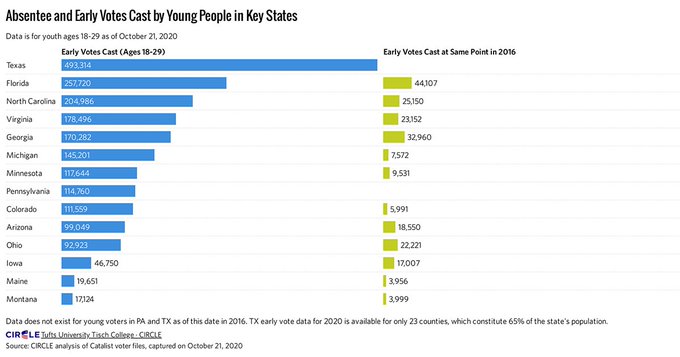
My own point on younger people: lots of them register as independents/unaffiliated. That’s a bit of a hidden factor when most analysts/TV chatter simply discuss Democrats versus Republicans—in places like Florida, that “unaffiliated” number is huge. Assuming these breakdowns are close to accurate, that’s a significant Biden edge.
Random other points to throw in the mix to fill out some of the picture, not as things that stand on their own as a major influence but are little pieces of the bigger puzzle:
- Fundraising: who would have predicted that, after trailing Trump in a big way in money, Biden/Democrats are blowing it out of the water on money—and entering into the final few days have a huge money edge over Republicans.
- Money raising above is a sign of enthusiasm (and that doesn’t even count the gobs of cash Senate candidates are raising).
- Money allows you to expand the map, rather than shrink it, and to run millions of dollars of ads in places like Texas because, why not?
- Third-party voters will matter even less, as I said above. A very tiny number of people are opting for third party candidates. (as an aside: I don’t want to pick a fight with the Green Party but it is quite something that the Green Party wants to project a different profile and, yet, nominates and old white guy who runs for something every election cycle, loses every single election and barely is noticed, is a mediocre campaigner and the party relegates the woman of color to the VP spot)
- In a poll of MILITARY voters at the end of August, 43 percent said they would vote for Biden, 37 percent said they plan to vote to re-elect Trump. That’s pretty astounding, given the track record of general support over many decades for Republican among the military—though, in considering this, remember the growing percentage of people of color in the military over the past 2-3 decades, folks who are quite aware of racism in their communities and the way in which Trump embraces racism. That military voters are polling this way will tell you something about why some of the demographic data–white men, for example–and some states are showing better results for Biden–but it also shows you how military voters view Biden as an (ugh) pretty strong pro-Pentagon voice (um, yeah, he voted for the Iraq War e.g.).
- The whole slew of anti-Trump Republicans, the former national security Republican crew and others matter, again, as a data point—it’s not so much that they actually sway huge numbers of people to vote for Biden, IMHO. Rather, they can give pause to a passel of Republicans—especially older voters—about whether they want to actually go out to vote for Trump. It’s also possible this helps Democrats in a few Senate races—i.e., voters who won’t vote for the top of the Democratic ticket but might not find it too hard to vote for a conservative/moderate Democratic challenger.
- Cindy McCain’s endorsement of Biden in Arizona matters on the margins, especially in the important Maricopa County.
- John Kasich is a dolt, anti-union and full of himself but in Ohio he has some sway among independents, conservative Democrats and a smattering of suburban Republicans so his endorsement of Biden matters in Ohio in terms of the general noise there and, again, in a close race, it’s worth maybe a percentage point or two.
- Sports: I’m a sports fan and, wow, the activism among athletes has been nothing short of amazing in the past six months. We’ve gone from Michael Jordan not wanting to take a position on politics in the 1990s because “Republican buy sneakers, too” to Colin Kaepernick kneeling alone (and, then, being denied a job) to…baseball players (one of the least African-American sports in terms of athletes) standing in support of BLM, to the NBA where virtually every player (and coaches) has a BLM message on their jersey and LeBron James—maybe the most popular player in all major sports—leading BLM messaging, urging people to vote and, my god, NASCAR (!!!) removing the confederate flags from their races and marching in unison and support on a racetrack, gaining national TV coverage, with an African American driver targeted because of his race and BLM statements. Who do you think gets more positive attention from voters, LeBron James or…Jon Voight/Eric Trump, Jr.?
- West Virginia! Trump will surely win the state and he’s up by between 14-18 points BUT…that’s a state he won with the biggest margin over Clinton, 68-26. That underperforming has implications in other states re: demographics (read: older white people)
- Utah: Trump is winning by 10 in a state he won by 18. That’s largely the Romney-Trump feud/Mormon effect. Still…
The “hidden” Trump voter: ah, yes, the idea that polling doesn’t capture this big group of voters who are too shy to admit they will vote for Trump has been a lingering topic of cable news speculation and Republican wet dreams.
I don’t buy it in 2020 for two basic reasons.
First, that “hidden” voter in 2016 was driven, IMHO, by two factors—racism and sexism. Most of those “hidden” Trump voters (read: older white MEN without college degrees) either hated Obama because he was black (and Trump amped that up with the “birther” meme because he’s a hard-core racist) or are deeply sexist/misogynists (you don’t have to be a fan of Hillary Clinton to recognize that sexism was a factor in her defeat). Obviously, with Biden as the opponent, it’s hard to gin up *persuadable* voters on those two factors.
Second, to the extent there is still some group of “hidden” Trump supporters, it’s quite a bit smaller since people have had the experience of Trump as president.
The other “hidden Trump” voter: my own small gut theory (“Gut” meaning I can’t prove it with data) also considers that there are plenty of “hidden Trump” voters…who voted for Trump in 2016 but are not going to vote for him in 2020 and are too embarrassed by the 2016 vote to say anything, or, even are telling pollsters they still support Trump. Crazy? I point to those substantially lower numbers in West Virginia, Montana and Texas as examples—he is underperforming in states he won handily…those people went somewhere.
People don’t like to admit that they are wrong—even to a partner or even themselves, not to mention a pollster. That’s human.
Because so many people are triggered by the “hidden Trump voter” fear, a few more words on that:
One of the most important drivers in campaign decisions and messaging are consultants/strategists/operatives and/or various party leaders looking to fill their pockets with cash and/or looking out for their own political futures. 95 percent of the aforementioned folks are craven, mostly interested in their own personal wealth and power.
So, when you read Republican leaders and strategists talking about the race being competitive, because of “hidden Trump” voters, despite the data they are seeing at the district level probably saying the opposite, understand:
- The consultants/campaign people do this in order to justify more spending of money AND to get big donors to keep pouring in money. Consultants make a huge part of their income from ad buys–they get a percentage of every ad placed. In a Trump campaign, that means millions of dollars in pay into the hands of a few. They have a huge financial incentive to put out the narrative that, oh, they can win Minnesota etc.
- People like Pence want to keep that narrative going because they are already looking at 2024. The same is true of high-level Trump mouthpieces. To them, it’s irrelevant if Trump loses as long as each of them can count on keeping the political base behind them–in Pence’s case–or count on big lucrative contracts from donors/Republican committees/Heritage Institute etc. And the only thing they have to show to keep the ka-ching, ka-ching going is loyalty–not facts.
I am not saying, again, that Trump can’t win (though I highly doubt it) or that the race won’t tighten in some states. Just filter what you hear from the Trump world with a grain of salt, with the above motivations in mind.
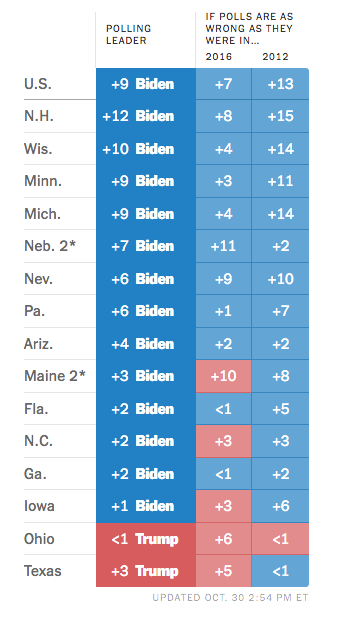
Ok, you’ve still got 2016 PTSD: you think the polling could be off again. Let’s assume it’s off by the same factor as 2016—that happened largely because pollsters under-sampled white people without degrees (a mistake that has been rectified in most legitimate polls) AND independents broke hard late for Trump. Courtesy of the New York Times, consider the table below—even if it’s off by a 2106 factor, Trump still loses (data is as of October 30th).
So-called “Battleground” states:
I would argue that they are not all created equal. Here’s what I mean: don’t look just at the presidential race but look in unison with other top ballot races. For example, some folks have worried about the changing nature of Minnesota; it is true that in the so-called Iron Range, which used to be heavily unionized and strongly Democratic, Republicans have shifted the balance there.
Yet, Biden has run consistently with a relatively comfortable polling lead…which is no surprise because Sen. Tina Smith is running for a full-term (she won the special election after replacing Al Franken) and she has been in the high single digits consistently. I don’t buy that MN is close in the presidential if Smith is running consistently in front—people do not, for the most part, split their ballots in modern politics, and virtually no one is going to cast a ballot FOR Smith and NOT for Biden (and to be consistent, the reason I am very skeptical—STILL— that Lindsey Graham will lose in SC, despite a tight polling picture—a couple of polls have had Graham a point or so behind— and a massive fundraising haul by Jamie Harrison, and, certainly, there is virtually no chance McConnell loses in KY, the reason I’ve been aghast at the millions of Democratic money wasted on the KY race)
My point is: look at top-tier Senate or Governor races, or even House races (taking the House races as a group) to get a better feel for how the presidential race will unfold.
Look at the “Battlegrounds” as linked:
- If Ohio is close and remains close—and it’s now a toss-up in some polls, and even with Biden leading in the most recent poll by 5 points—then, because of demographics, you can probably view that as a barometer of the reliability of what you hear about Michigan and Wisconsin.
- Similarly, if Texas stays relatively close, even if Trump is ahead by say 4-5 points, you can probably view that as a reliable barometer of Arizona and a bit about Florida (in terms of reading enthusiasm or not among *some* Latino voters—i.e., not Cuban community voters).
- Because of demographics, I could see Biden winning Texas but losing Ohio–that still is a linkage because of demographics.
Debates UPDATED. So, both debates happened and, as I suspected, did not generally shift the contours of the race:
- The huge mail-in balloting that was already underway
- There is a very small slice of voters who are undecideds. Most people watching both debates—or any other debate—were like partisans at a sporting event—rooting for their “team”, not trying to figure out what team to root for.
- I am adding this slight caveat here to the “debates don’t matter”. That’s true with normal people—Trump’s unhinged performance in the first debate simply hardened peoples’ positions, which aligns with my point above that debates don’t shift the basic contours of the race i.e., Trump heading for
About pollsters: so, I take any individual poll with a healthy amount of skepticism. There are a handful of pollsters that are highly rated (A+ to A-) that I try to look at, over time, and comparing apples to apples (same state, likely voter poll). Here they are with, in parenthesis, their perceived “house bias” (i.e., they tend to skew one way or the other—meaning, the way they decide the makeup of their poll tends to favor one party or the other but not hugely): Marist College (R+0.3), Monmouth University (D+1.3), ABC News/The Washington Post (D+0.5), Siena College/The New York Times Upshot (R+0.3), Selzer & Co. (D+01); Muhlenberg College (R+0.2); SurveyUSA (D+0.1); Suffolk University (D+0.6); CBS News/The New York Times (D+0.4); Emerson College (D+0.3); Siena College (R+0.7); Fox News/Beacon Research/Shaw & Co. Research (D+1.4); RKM Research and Communications Inc./NBC News/The Wall Street Journal (R+0.1)
The Senate–Like 1980…in Reverse:
At this point, given the dynamic in the presidential race, I am far more focused on the Senate races—and progressives should be as well because any hope we have of pushing the Biden centrist wing for more progressive policies is dead in the water if Bernie Sanders, for example, is not the chair of a major committee and is still in the minority.
I still am relatively bullish on the Senate results for the same reasons I’ve stated for a number of months: I think that the presidential results could mirror the 1980 presidential-Senate results and result in up to 54 Democrats in the Senate (reminder: Bernie Sanders and Angus King are technically “independents” but caucus with the Democrats and are considered in the Democratic count). I don’t see a lot of ticket splitting going in the Senate races (i.e., voting for different parties in the presidential and Senate contests in the same states) with two caveats: Montana and perhaps Alaska. Trump will win Montana (if he doesn’t, then, toss out the above and it’s more likely he barely reaches 75 EVs…wipeout) and maybe Alaska (see below) but I think Bullock’s personal popularity lets him squeeze through over Daines and it’s a weird one in Alaska.
In short, in the final 1980 stretch, the bottom fell out for Jimmy Carter and, aside from the electoral landslide for Reagan, Republicans gained a net of 12 seats, taking control of the Senate for the first time since 1954 with 53 seats—this was a breath-taking reversal at the time and entirely unexpected. That election knocked out long-time incumbents like Culver from Iowa, Talmadge in Georgia, Frank Church in Idaho, Birch Bayh in Indiana (who, egads, lost to the leading light, Dan Quayle) and, yes, George McGovern in SD who just 8 years prior was the Democratic Party’s candidate for president.
You can say, with the knowledge of today about the politics, oh, it’s obvious McGovern would lose in SD. But, six years later, Tom Daschle won the Senate seat back from James Abdnor and went on to serve through 2005, including stints as minority and majority leader of the Senate. A number of those races where incumbents lost were quite tight—e.g., Talmadge lost by less than two points to a nobody.
It was the top of the ticket imploding that drove a majority of those loses, many of which were surprises at the time…
….which is possible in 2020—you might end up with surprises like Cornyn losing Texas, where the polls are so-so for him. I’m not saying, today, that I think Cornyn will absolutely lose with the same certainty I have about say AZ or CO—but I would not be surprised if it happens.
The best indicator, which I predicted a while ago, that the Senate is tilting towards Democrats is when Republicans, and donors, start talking up the Senate as the bulwark against Biden “socialism” and, voila, Thom Tillis (Republican—NC), just recently, talked openly about a Trump defeat: “The best check on a Biden presidency is for Republicans to have a majority in the Senate.”
Almost A Lock:
Colorado, Maine, Arizona
I would take CO and AZ to the bank at this point. Maine is almost as certain a bet because incumbent Susan Collins has never led in any poll over Sarah Gideon going back to February and Biden is polling at between 12-17 points up in the state—the fact that Collins is keeping the race to low single digits is just a reality of her incumbency over 4 terms but, in this hyper-partisan world, I don’t see how she survives the wave.
The In-Reach Seats:
North Carolina, Iowa
North Carolina: horray Despite Cal Cunningham’s inability to keep it in his pants, he still seems to be holding on to his 4-5 point lead over Tillis—a most recent poll has him up by 10 points (I think that might be a bit much). Which is another “horray”: voters seem not to care about sex between consenting adults, no matter the circumstances.
Iowa: Theresa Greenfield has led in most pols since June, with a lead averaging a shade under 5 points over incumbent Republican Joni Ernst, though a recent poll has Ernst up a couple of points. Ernst is sort of in the opposite bind that Susan Collins is in— a first-term Senator (Collins has held her seat since 1996) who has made very little of a positive impression on voters in a very competitive state. Biden is a tiny bit in the lead in Iowa—a point or two.
The Wildcards: these are the seats that have unusual circumstances but are gettable in a landslide at the top.
Montana, Georgia (2 seats), Texas, Alaska…and Kansas!
Montana: one of the few places where I think Trump could win but Democratic challenger Steve Bullock, a fairly popular Governor, could unseat the Republican Daines. Trump is up by mid-single digits—in a state he won by 20 points in 2016; Biden is getting 8 percent of the voters who say they voted for Trump in 2016, in the most recent poll. That leakage of support is the reason the Senate race is somewhere between a tie and a 2-3 point lead for Daines. One of the very few places where ticket-splitting in enough numbers could be meaningful.
Texas: I went out on a limb—or, so some have said—allocating Texas to Biden, and I did no largely because of this: Since 2016, Texas has added 1.5 million voters to the registration rolls, which is nearly two times Trump’s 2016 margin of victory of 800,000 votes; turnout in Texas in early voting, to date, has been massive. We saw a whisper of the potential in 2018 when Beto O-Rourke came within three points of defeating Ted Cruz—but, in fairness, there are a substantial number of Republicans who hate Cruz who is another level higher of despicable.
If it turns out Biden wins Texas, Cornyn will probably lose as well. But, this is certainly on the outer reaches of seats to count on.
Alaska: this is a weird one. Alaska, yes, is Republican in one sense but it has a bit of an NH-type independent streak—recall, after she lost her primary, Lisa Murkowski won her re-election in 2010 with a write-in campaign, which is almost impossible to pull off anywhere and was the first in something like 50 years in a Senate election.
The race is actually a relatively unremarkable Republican incumbent against an independent. There is very little public polling there to look at over say six months. Back in August, a pollster with a B rating found 43% for the incumbent Sen. Dan Sullivan and 43% for the independent Al Gross, who actually has Democratic Senatorial Campaign Committee backing. Fourteen percent of respondents said they were unsure; a more recent poll had Sullivan up, however, by 8. And Biden and Trump were virtually tied. A more recent poll from a slightly less valued pollster (B/C rating) last week showed roughly the same result—Sullivan and Trump leading by just a point…essentially a tie (within the margin of error).
However, Alaska is not an easy state to poll. So, do not be surprised if the independent wins that one—and that would be a Democratic-counted seat.
Georgia: Warnock is now leading the field in the special election (the son of Iraq-War-Cheerleader-turned-Big-Pharma-lobbyist scar Joe Lieberman seems to have fallen far behind as people realized he was hurting the party’s chances) and he *might* actually inch above 50 percent at the end. If not, this race goes to a run-off on January 5th. The second race is in the same general place—Osoff is ahead of Perdue and could inch above 50 percent. Their chances are looking better because Biden looks very competitive in Georgia.
If Democrats already have gained control of the U.S. Senate on Election Day, I think Warnock and Osoff could win the runoffs because Republicans will be deflated and won’t turn out (special elections are notoriously low turnout). If the Senate is still in play and would be decided by one or both of these races, it’s a toss-up in the run-off because there will be tens of millions of dollars pouring into the run-off. It’s very hard to judge a run-off where both sides are competing aggressively.
Kansas: I’m adding Kansas here. Not a lot of polling here. Most recent reliable poll has Republican Marshall up by 4 points over Republican-turned-Democrat Barbara Bollier. Bollier has a lot of young progressives working for her on the ground and she’s kept this race pretty close in a state that hasn’t elected a Democrat to the U.S. Senate since FDR was president…I’m skeptical, however. But, again, put another way—if she wins Kansas, nationally it won’t be a GOP rout but an existential shellacking.
I’m not even listing South Carolina. Yes, there’s all sorts of excitement about beating Lindsey Graham (it would be glorious!) but the underlying demographics in SC just are far more favorable to Graham than for Cornyn in Texas. A presidential election year is likely to drive higher turnout of Trump-leaning Republicans who vote for Graham; in a mid-term election, lower-turnout election, I could totally see Graham losing his seat.
The Stupid, Silly Ones
Kentucky: months ago, I posted the easiest political observation on the planet—every dollar spent on the Kentucky Senate race on behalf of the Democratic candidate (McGrath) is a waste of time (that would have been true had the more progressive candidate had won the primary). All the money thrown at defeating Mitch McConnell has been a *wasted* dollar potentially winning other seats to actually take power away from McConnell and make him the minority leader next year. Trump will win the state by a margin of between 10 and 20 points. Put another way, if lightning strikes and McConnell loses, it won’t matter in terms of power in the Senate because it would mean that Trump collapses and you are looking at a wave like 1980—and that money would have been better used in state house legislative battles. Yes, I will join the celebration if McConnell loses but a part of me thinks the *worst* outcome for McConnell, and a delicious serving of karma, is for him to be the Senate *minority* leader, with no power, and watch everything be done to undo the damage he has caused.
CAVEATS: what a bummer, huh?
The above could be wrong. [Inside-the-head-voice] “You chicken, you.”
Usually, each election, I talk to various people who are out there in various states doing voter outreach, canvassing, etc. to get a feel…(e.g., someone I spoke to in 2016 who knew the South very well was ranted to me about the incompetence of the Democratic Party in Florida…)
But, COVID feels like groping in the dark. There is nothing to base it on historically—I don’t know how to weigh the lack of door knocking and in-the-street mobilizing that won’t happen versus the massive phoning/texting/social media that has taken its place. It’s the most unsettling part of the whole picture.
And: no one knows what the pandemic will look like on Election Day, which, by all accounts, will be a larger Republican-leaning vote—will it be raging everywhere, or just in specific states (e.g., right now, there is a surge in the Midwest and West)?
I do not underestimate the ballot shenanigans Republicans will attempt—and are attempting every single day. That’s a real threat. Which we have to be prepared to shut down the country for.
I had some concern that the “October Surprise” might be the madman claiming we had a COVID vaccine. I now think that that is unlikely, most companies working on a vaccine are saying it won’t happen and, more important, there is too much disbelief that it is possible and any claim of a safe vaccine magically appearing will be rapidly discounted—and, worse for Trump, a large majority believe he’s dishonest. Lastly, it’s almost karmic: the October non-surprise turns out to be Trump getting COVID, along with a bunch of his visible aides which JUST REINFORCED to people the underlying issue in the election—see my opening remarks.
LASTLY: none of the above, in any way, lessens my view that should Biden win, all of us progressives are going to have a battle royal against Biden. His appointments will be deficit hawks, anti-Medicare For All and foreign policy “moderates” (“moderates” meaning very happy with big military spending, war, American Exceptionalism etc.). It might require a general strike against the Democrats. I’m ready for all of that. But, we have to obliterate Trump first.